











































When PSG beat Inter Milan 5-0 in last season’s Champions League final, it looked almost easy. Budapest was the opposite — a grinding, uncomfortable night that tested everything Luis Enrique had built since taking charge in Paris. In the end, his side won. But understanding how they won tells you a great deal about both clubs going into next season.
Arsenal’s Low Block: The Plan That Nearly Worked
Mikel Arteta made a calculated decision before kick-off. Despite winning the Premier League in some of the most attractive football seen in England for years, Arsenal set up to suffocate. Their 4-4-2 mid-block, compact in two lines and quick to shuttle across, was designed to deny PSG the central corridors they rely on to build attacks.
It nearly worked to perfection. Arsenal only conceded six goals across 14 Champions League matches this season — a defensive record that stands comparison with any in recent tournament history. In normal time on Saturday, they registered just five shots against compared to PSG’s 19, yet led going into the second half.

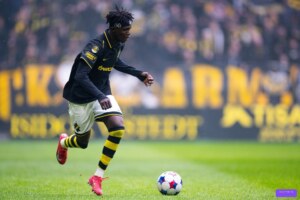

The key to their defensive shape was Myles Lewis-Skelly at left midfield rather than his natural defensive position. At 18 years old, his energy and intelligence in tracking PSG’s right-side overloads — particularly Achraf Hakimi bombing forward — meant Arsenal never conceded the width they feared most.
PSG’s Patience: The Positional Build-Up
Luis Enrique’s side dominated the ball as expected, but the manner in which they sought to create was telling. Rather than the high-tempo vertical passes that destroyed Inter, PSG were patient and horizontal, probing for the half-spaces Arsenal’s block created on either side of Declan Rice.
Fabian Ruiz and Vitinha operated as the double pivot, constantly offering passing angles, while João Neves — the most technically complete midfielder on the pitch — drove into channels whenever Arsenal’s shape compressed. The idea was to pull the Gunners’ defensive lines out of their positions and find Kvaratskhelia in the space behind.
For the first 60 minutes, it didn’t work. Arsenal’s centre-halves, William Saliba and Gabriel Magalhães, were immaculate. But then Cristhian Mosquera — playing right-back after Hakimi needed a rest — gave away the penalty that changed everything.
The Substitution Battle
Where Arteta and Enrique diverged most sharply was in their use of the bench. Arteta brought Gyökeres on to hold the ball in the final third and relieve pressure, but the sacrifice was tactical flexibility. By bringing Martinelli and Madueke on at the start of extra time, he had used his most natural penalty takers — Saka, Havertz, Odegaard, Trossard — and none of them were on the pitch when the shootout arrived.
Luis Enrique, in contrast, brought on Barcola and Ramos at different times to add direct running and press Arsenal’s increasingly tired defenders. Zaire-Emery’s introduction for Ruiz added energy to the press without sacrificing the technical quality PSG needed to keep the ball.
The Penalty Dilemma That Decided the Final
Arteta’s most difficult night may be defined not by the tactics during 120 minutes, but by the decisions around the shootout. Of Arsenal’s five most reliable spot-kick takers over the past two seasons — Saka, Havertz, Odegaard, Trossard, and Rice — only Rice was still on the pitch when penalties arrived. That is not bad planning by Arteta; it is the reality of managing through extra time. But it is a dilemma that will be debated at length.
Rice, Martinelli, and Gyökeres all converted under pressure. Gabriel, asked to score in the most pressured moment of his career, did not.
Looking Ahead
PSG’s victory confirmed something important: this is a team built for sustained dominance, not a one-year wonder. With Doué, Zaire-Emery, and Barcola all under 22 and Kvaratskhelia hitting his peak form, they will be favourites again next season. For Arsenal, the road back starts the moment the Budapest turf is watered for the next game. They were good enough to reach a final. Whether they can win one remains the question.
